
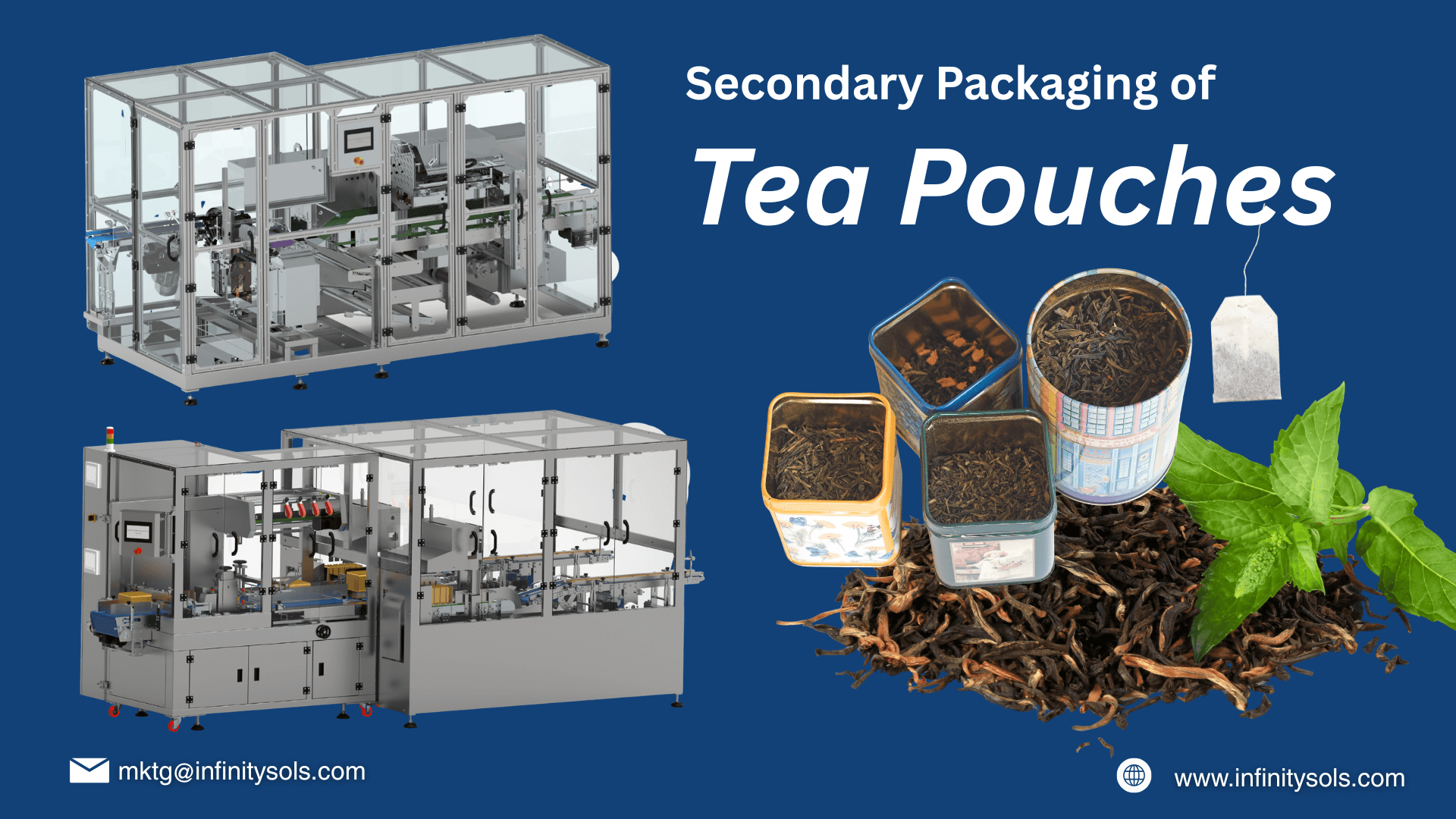
Secondary Packaging of tea pouch, bags and case packing
Secondary packaging of tea pouch is very important for tea manufacturers who produce multiple pack sizes. Tea is sold in small trial packs, regular retail packs, and bulk family packs. Each variant requires a different secondary packaging solution to ensure safe handling, easy transportation, and attractive market presentation.
Because tea pouches come in different weights like 10 gm, 50 gm, 200 gm, 500 gm, 1 kg, and 2 kg, manufacturers use different machines for different variants. This helps maintain speed, accuracy, and packaging efficiency.
Secondary Packaging for 10 gm and 50 gm Tea Pouch – Using IBS (Strip Bundling Machine)
Small tea pouches such as 10 gm and 50 gm are often packed in strip format for retail sales, promotional offers, or rural markets. In this case, an IBS (Infinity Bundling System) or strip bundling machine is used.
The strip bundling machine joins multiple small tea pouches into a single strip. This format is easy to display in small shops and convenient for customers to purchase in small quantities. It also reduces loose handling and keeps the pouches organized during transport.
Strip bundling improves packing speed and creates uniform bundles, which helps in better shelf management and reduced product damage.
Secondary Packaging for 200 gm and 500 gm Tea Pouch – Using Pouch Bundling Machine
Medium-size tea pouches such as 200 gm and 500 gm are commonly sold in supermarkets and grocery stores. For these variants, a pouch bundling machine is used.
The pouch bundling machine groups multiple tea pouches together and wraps them securely. This method is useful for promotional packs like “Buy 2 Get 1” or wholesale distribution. Bundling keeps the pouches stable and protected during storage and transportation.
This type of secondary packaging ensures better product alignment, reduces manual work, and increases production efficiency.
Secondary Packaging for 1 kg and 2 kg Tea Pouch – Baling or Bagging
Large tea pouches such as 1 kg and 2 kg are usually meant for bulk buyers, hotels, distributors, or export markets. For these variants, baling or bagging is done as per requirement.
An automatic bagging machine collects multiple large pouches and packs them into bigger poly bags for easy handling. Alternatively, a baling machine compresses and secures the pouches into compact bundles. This helps in saving storage space and improving logistics efficiency.
The choice between baling or bagging depends on the customer requirement, transportation method, and warehouse handling process.
Different Machines for Different Variants
In tea manufacturing, one packaging solution cannot fit all pack sizes. Small pouches need strip bundling, medium pouches require bundling machines, and large pouches need bagging or baling systems. Using the right machine for each variant ensures smooth operation, high speed, and proper product protection.
Integrated conveying systems and checkweighers can further improve accuracy and workflow across the entire secondary packaging line.
Companies like Infinity Automated Solutions Pvt Ltd provide complete secondary packaging solutions including strip bundling machines, pouch bundling machines, bagging systems, and baling machines to support tea manufacturers.
Conclusion
Secondary packaging of tea pouch depends on the product weight and market requirement. From 10 gm strip packs to 2 kg bulk packs, each variant needs a specific machine to ensure efficiency and safety. By choosing the right secondary packaging system, tea manufacturers can improve productivity, reduce manual handling, and deliver well-packed products to the market.