
In modern manufacturing and packaging industries, efficient material handling plays an important role in maintaining smooth production operations. Moving products from one processing stage to another manually can increase labour requirements, consume valuable time, and affect overall production efficiency.
A Belt Conveyor System provides an effective solution for transporting products, raw materials, and finished goods across different stages of a production line. It uses a continuously moving belt to transfer materials from one location to another with minimal manual intervention.
Belt conveyors are widely used in food processing, FMCG, pharmaceuticals, warehousing, logistics, automotive, and packaging industries. They help manufacturers improve material movement, maintain continuous production flow, and streamline industrial operations.
What Is a Belt Conveyor?
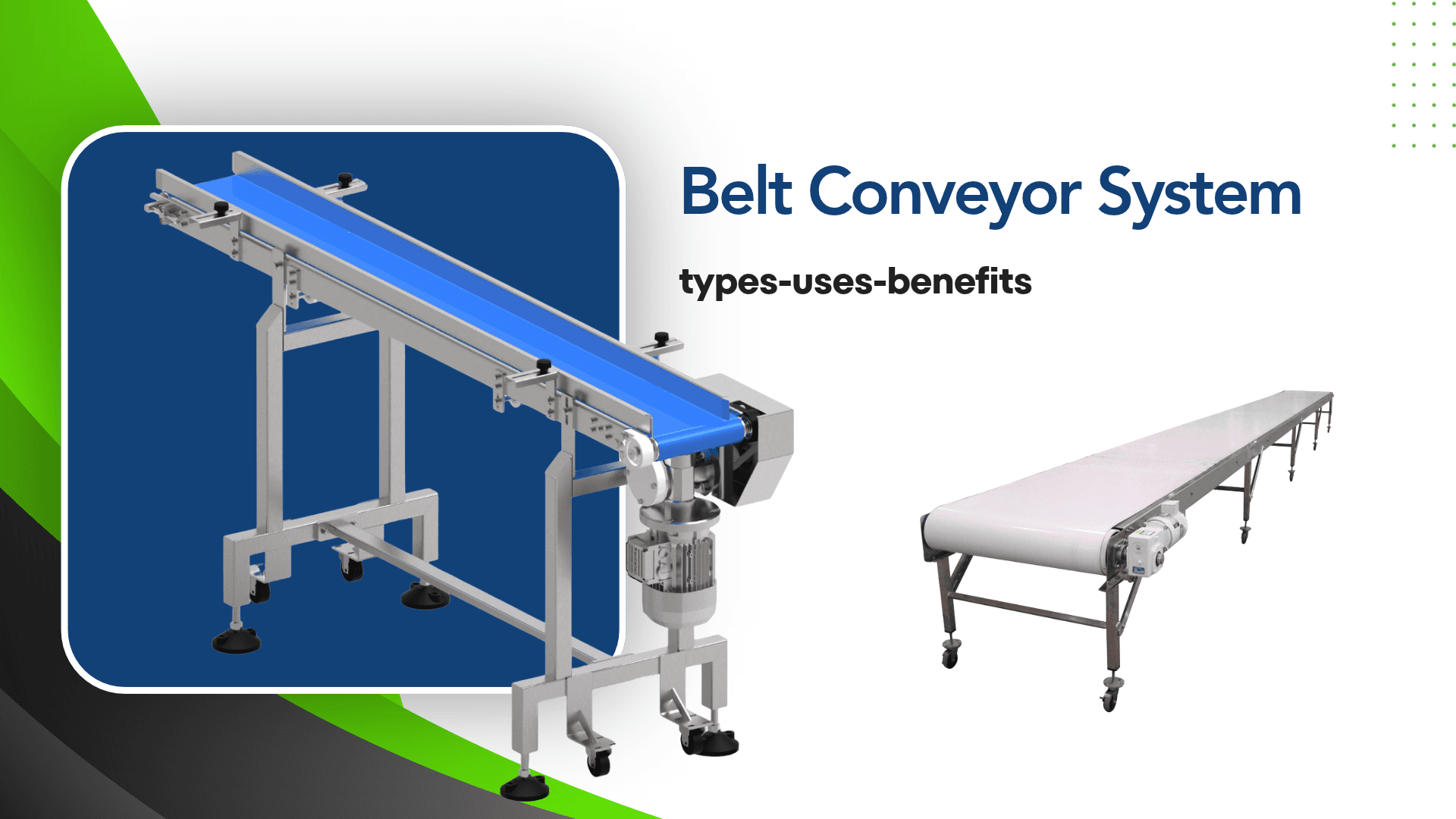
A belt conveyor is a mechanical material handling system that uses a continuous belt supported by rollers or a sliding surface to transport products and materials.
The belt moves over pulleys and is driven by an electric motor, allowing products to travel between different locations within a manufacturing facility.
Depending on the application, belt conveyors can be designed to handle different product sizes, weights, shapes, and materials.
They are commonly used for:
• Transporting packaged products.
• Moving raw materials.
• Transferring products between machines.
• Feeding products into packaging lines.
• Moving finished goods towards inspection and dispatch areas.
How Does a Belt Conveyor Work?
A belt conveyor operates through a simple mechanical arrangement involving a motor, pulleys, rollers, and a continuous conveyor belt. The working process generally involves the following steps:
Step 1: Product Loading
Products or materials are placed onto the conveyor belt manually or through an automated feeding system.
Step 2: Motor Operation
An electric motor drives the conveyor pulley, creating the movement required to operate the belt.
Step 3: Belt Movement
The continuous belt moves along the conveyor frame, carrying products from the loading point towards the discharge point.
Step 4: Product Transportation
Products travel along the conveyor without requiring repeated manual handling.
Step 5: Product Discharge
At the discharge point, products are transferred to another conveyor, processing machine, packaging machine, or collection area.
This continuous movement helps maintain an organised and efficient production workflow.
Different Types of Belt Conveyor Systems
Different industries require different conveyor configurations depending on their product characteristics, factory layout, and material handling requirements.
A. Flat Belt Conveyor
A flat belt conveyor uses a flat, continuous belt to transport products horizontally.
It is suitable for handling cartons, boxes, pouches, packaged food products, and other lightweight materials.
Applications:
• Packaging industries.
• Food processing plants.
• FMCG production lines.
• Warehousing and distribution.
B. Inclined Belt Conveyor
An inclined belt conveyor is designed to transport products from a lower level to a higher level or vice versa.
It is useful when products need to move between different floor heights or production stages.
Applications:
• Product feeding systems.
• Packaging machine feeding.
• Material transfer between production levels.
• Food processing facilities.
C. Modular Belt Conveyor
A modular belt conveyor uses interconnected plastic belt modules to create a continuous conveying surface.
It offers flexibility in conveyor design and is suitable for applications that require specific belt configurations.
Applications:
• Food and beverage processing.
• Packaging lines.
• Product handling systems.
• Industrial manufacturing.
D. Cleated Belt Conveyor
A cleated belt conveyor has raised sections or cleats attached to the belt surface.
These cleats help prevent products from slipping backwards when being transported on inclined conveyor sections.
Applications:
• Bulk material handling.
• Agricultural products.
• Food processing.
• Inclined product transportation.
E. Portable Belt Conveyor
A portable belt conveyor is designed for applications where material handling equipment needs to be moved between different locations.
It is useful for temporary material transfer and flexible production arrangements.
Applications:
• Warehouses.
• Loading and unloading operations.
• Distribution centres.
• Material handling facilities.
Applications of Belt Conveyor Systems Across Industries
Belt conveyors are used in various industries because they provide a practical solution for continuous product transportation.
Food Industry: Transporting biscuits, snacks, bakery products, packaged foods, and other food items between production and packaging stages.
FMCG Industry: Moving soap cartons, detergent packs, consumer goods, and packaged products.
Pharmaceutical Industry: Transferring medicine cartons, bottles, and other packaged healthcare products.
Packaging Industry: Feeding products into packaging machines and transferring finished packs towards inspection, secondary packaging, and dispatch.
Automotive Industry: Moving components and parts between different assembly and production stations.
Warehousing and Logistics: Transporting cartons, packages, and finished goods for sorting, handling, and distribution.
Benefits of Using Belt Conveyor Systems
Installing a suitable belt conveyor system can improve material handling efficiency and support continuous production operations.
1. Improved Productivity
Belt conveyors provide continuous product movement, helping reduce delays between different production stages.
2. Reduced Manual Handling
Automated transportation minimises the need for workers to carry products manually between machines.
3. Smooth Product Transportation
A properly designed conveyor system helps maintain controlled and consistent product movement.
4. Flexible Installation
Belt conveyors can be designed in different lengths, widths, and configurations according to factory requirements.
5. Better Production Line Integration
They can be integrated with packaging machines, inspection systems, checkweighers, and other material handling equipment.
6. Efficient Space Utilisation
A properly planned conveyor layout helps organise product movement and make better use of available factory space.
7. Continuous Material Handling
Conveyors support the smooth transfer of products between different production and packaging operations.
How to Choose the Right Belt Conveyor Manufacturer?
Selecting the right belt conveyor manufacturer is important for achieving reliable material handling performance.
Before purchasing a conveyor system, consider the following factors:
Product Characteristics: Understand the product dimensions, weight, shape, and surface characteristics.
Conveyor Length and Width: Select suitable conveyor dimensions based on product size and factory layout.
Loading Capacity: Determine the quantity and weight of products the conveyor needs to handle.
Belt Material: Choose an appropriate belt material based on the application, operating environment, and product requirements.
Conveyor Speed: Consider the required transportation speed and its compatibility with connected machines.
Factory Layout: Evaluate available installation space, conveyor direction, and transfer points.
Machine Integration: Ensure the conveyor can work efficiently with existing production and packaging equipment.
Maintenance Requirements: Consider accessibility, cleaning requirements, belt replacement, and maintenance support.
A well-designed conveyor system can improve material handling efficiency and support the long-term requirements of a manufacturing facility.
Importance of Belt Conveyors in Packaging Automation
In automated packaging lines, belt conveyors connect different machines and help maintain continuous product movement.
For example, in a secondary packaging line, products may move through the following stages:
1. Individual product packaging.
2. Product transfer through belt conveyors.
3. Product inspection and weight checking.
4. Pouch bundling or carton packing.
5. Finished product collection.
6. Transfer towards dispatch.
Without an efficient material handling system, even a high-speed packaging machine may experience interruptions due to inconsistent product feeding or discharge.
Integrating suitable conveyors with packaging equipment helps improve production flow and reduce unnecessary manual movement.
Why Choose Infinity Automated Solutions for Conveyor Systems?
Infinity Automated Solutions Pvt. Ltd. specialises in secondary packaging and end-of-line automation solutions for industries including food, FMCG, healthcare, cosmetics, and other manufacturing sectors.
With over 10 years of industry experience, 800+ installations worldwide, and 20+ packaging solutions, Infinity focuses on providing automation solutions based on customer production requirements.
Our solutions include:
• Belt Conveyor Systems.
• Roller Conveyor Systems.
• Modular Belt Conveyors.
• Product Transfer Conveyors.
• Pouch Bundling Machines.
• Case Packing Machines.
• Cartoning Machines.
• Automated Bagging and Baling Systems.
Our conveyor solutions help connect different stages of production and packaging operations, supporting smooth product movement and efficient material handling.
Conclusion
Belt conveyor systems are an essential part of modern industrial material handling and packaging automation. They help manufacturers transport products efficiently, reduce manual handling, improve production flow, and connect different stages of manufacturing operations.
Choosing the right conveyor design and working with an experienced conveyor manufacturer can help businesses develop an efficient and reliable material handling system.
Looking for a belt conveyor system for your manufacturing or packaging facility?
Contact Infinity Automated Solutions to discuss your product handling requirements and explore suitable conveyor automation solutions.
Website: https://infinitysols.com/ OR call now at 8484922042