
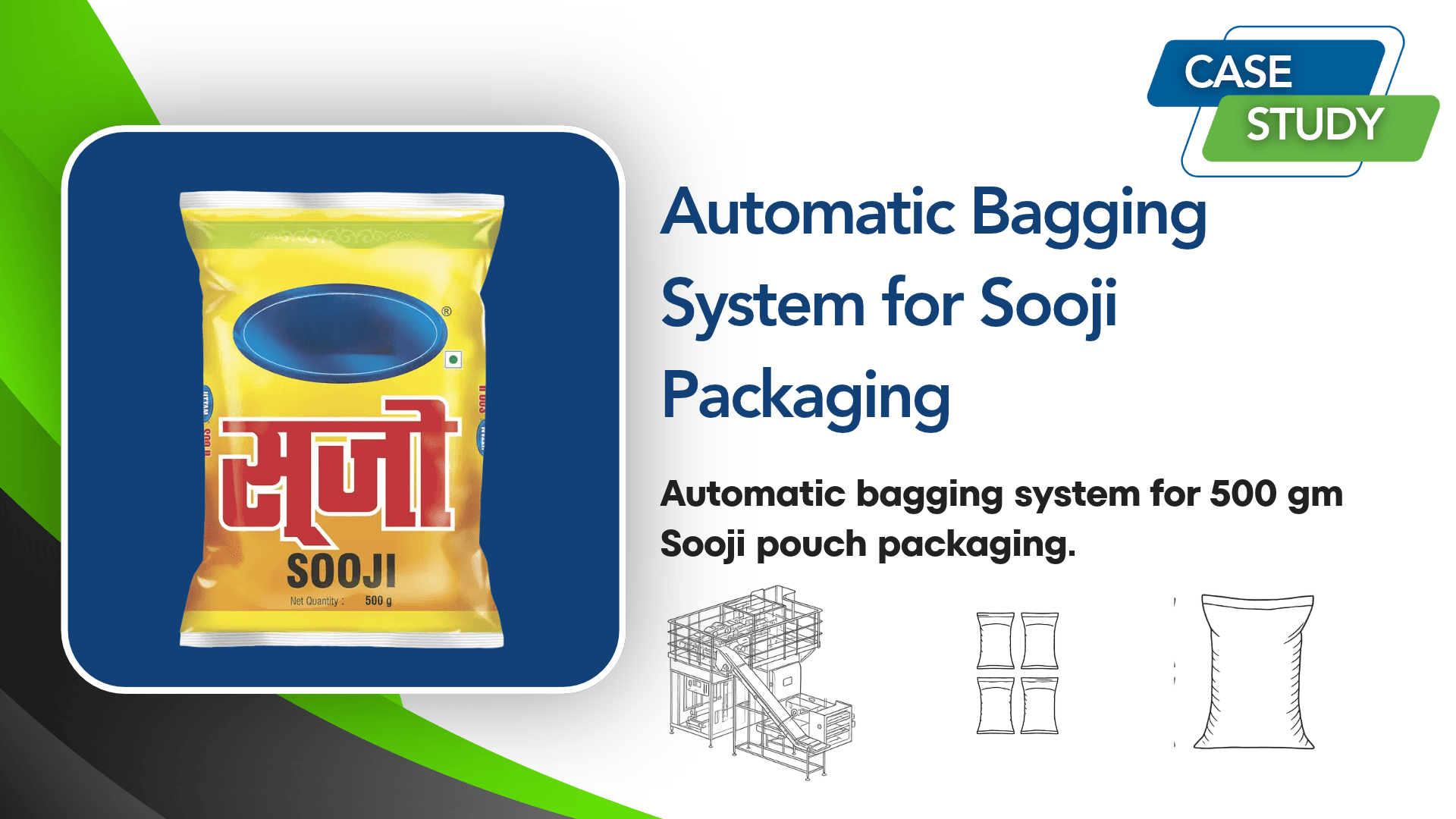
" How an automated end-of-line packaging solution improved productivity, reduced manual intervention, and ensured consistent bagging of 500 gm Sooji pouches. "
Manual bagging and secondary packaging operations can create challenges for manufacturing industries, especially when production volumes increase. Handling individual pouches, forming combos, arranging products into matrices, loading bags, and stitching them manually can require significant manpower and coordination.
In this case study, a food manufacturing operation required a complete automation solution for its 500 gm Sooji pillow pouches. The objective was to automate the complete end-of-line process, from pouch handling to final bag stitching, while improving packaging consistency and operational efficiency.
A fully integrated automatic bagging solution was implemented to streamline these operations.
The Challenge: Moving from Manual to Automated Packaging
The existing packaging process depended heavily on manual activities. This created a need for a more efficient and consistent approach to secondary packaging and bulk bagging.
The key challenges included:
High manpower dependency: Manual bagging and packaging activities required continuous operator involvement.
Pouch handling: Efficiently handling 500 gm Sooji pillow pouches after primary packaging.
Combo formation: Arranging the required number of pouches into consistent groups.
Matrix formation: Organising pouch combos into a defined arrangement before bag loading.
Bag loading and stitching: Ensuring smooth and consistent bag filling, followed by secure stitching.
Process coordination: Connecting secondary packaging operations with the existing VFFS packaging line.
The requirement was clear: automate the complete end-of-line process while maintaining consistency at every stage.
The Solution: Integrated Automatic Bagging System
A complete end-of-line automation solution was implemented using an IBG-8 Automatic Bagging System.
The system was designed to handle 500 gm Sooji pillow pouches and automate the activities involved in combo formation, matrix formation, bag loading, and stitching.
The solution included:
IBG-8 Automatic Bagging System: Automated bulk bagging of finished pouches.
Automated Pouch Handling: Smooth handling and transfer of 500 gm Sooji pouches.
Combo Formation System: Automatic grouping of pouches into predefined combos.
Matrix Forming Technology: Systematic arrangement of pouch combos before bag loading.
Automatic Bag Loading: Controlled loading of the formed matrix into bulk bags.
Automatic Bag Stitching: Stitching of filled bags for secure and dispatch-ready packaging.
VFFS Line Integration: Integration with the primary packaging line for a coordinated production flow.
This integrated solution connected primary packaging with secondary packaging and final bagging operations.
Automated Packaging Process Flow
The complete operation follows a systematic sequence:
VFFS Packaging Line → Product Collation → Combo Formation → Matrix Forming → Automatic Bagging → Bag Stitching → Dispatch
Step 1: Pouch Output from the VFFS Machine
The VFFS packaging machine produces individual 500 gm Sooji pillow pouches. These finished pouches are transferred to the secondary packaging system.
Step 2: Product Collation
The pouches are collected and organised for the next stage. This creates a controlled product flow for automated grouping.
Step 3: Automatic Combo Formation
The system groups the required number of pouches into predefined combos. This reduces the need for operators to manually count and arrange individual pouches.
Step 4: Matrix Formation
The formed combos are arranged into a systematic matrix. This arrangement helps maintain consistency before the products are loaded into bulk bags.
Step 5: Automatic Bag Loading
The prepared matrix is transferred into the bag-loading section. The automated system manages the loading operation, reducing manual handling.
Step 6: Bag Stitching
After the required quantity of product is loaded, the bag moves to the stitching section. The filled bag is stitched to secure the contents.
Step 7: Dispatch-Ready Packaging
The completed bags are discharged for further handling and dispatch. The result is a coordinated and automated end-of-line packaging process.
Results Achieved Through Automation
The implementation transformed the manual packaging process into an integrated automated operation.
The key operational improvements included:
Reduced Manpower Dependency:
Automated handling, grouping, bag loading, and stitching reduced the need for manual intervention.
Improved Packaging Consistency:
Automated combo and matrix formation helped maintain a uniform packaging arrangement.
Reliable Bagging Operations:
A coordinated process improved the consistency of bag loading and stitching.
Better Production Flow:
Integration with the VFFS line connected primary and secondary packaging operations.
Improved Operational Productivity:
Automation streamlined multiple packaging activities into one continuous process.
Dispatch-Ready Output:
Filled and stitched bags were prepared for the next stage of material handling and dispatch.
Why Automate Secondary Packaging and Bagging Operations?
For food manufacturers handling products such as Sooji, flour, rice, spices, and other powdered or granular products, secondary packaging is an important part of the production process.
When pouch production increases, manual grouping and bagging can become difficult to manage consistently.
An integrated automatic bagging solution can help manufacturers:
Reduce repetitive manual packaging activities.
Improve pouch grouping and arrangement.
Maintain consistency in bulk bag formation.
Connect primary packaging with end-of-line operations.
Improve overall production coordination.
Prepare finished bags for storage and dispatch.
The right automation system depends on pouch dimensions, product characteristics, required bag quantity, production speed, and the available factory layout.
Conclusion
This case study demonstrates how a manual Sooji pouch packaging operation can be transformed through complete end-of-line automation. See Video - IBG 500gm pouch
By integrating pouch handling, combo formation, matrix forming, automatic bag loading, and stitching, the solution created a coordinated packaging process from the VFFS line to dispatch-ready bags.
Complete automation of bagging, combo formation, matrix forming, and stitching can help food manufacturers improve packaging consistency, reduce manual intervention, and build a more efficient production operation.