
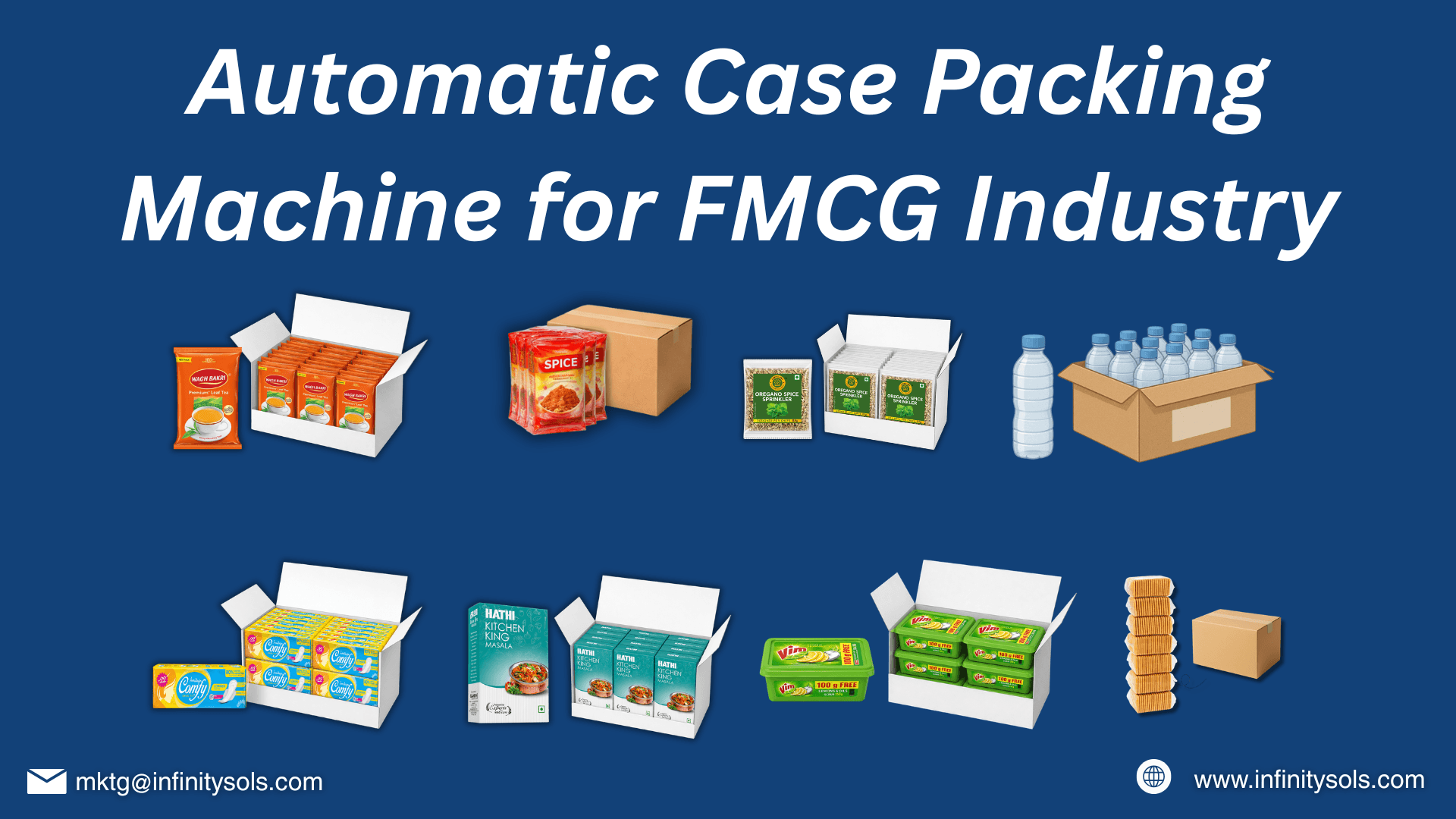
Automatic Case Packing Machine for FMCG Industry
An Automatic Case Packing Machine is a critical solution in modern secondary packaging, designed to streamline the process of loading primary products—such as pouches, cartons, bottles, or sachets—into corrugated cases with speed, precision, and consistency. Built for high-performance production lines, these machines eliminate manual intervention by automating case erecting, product collation, packing, and sealing. Whether handling FMCG goods, tea, spices, biscuits, or consumer products, an automatic case packer ensures uniform packing quality while significantly increasing throughput.
Equipped with advanced servo-driven systems and intelligent controls, the machine enables accurate product placement and flexible configuration for multiple pack patterns. From top-load to side-load case packing, it adapts easily to different product formats and case sizes, making it ideal for manufacturers with diverse SKUs.
One of the key advantages of an automatic case packing machine is its ability to maintain high efficiency with minimal downtime. Features like quick changeover, user-friendly HMI interfaces, and integrated safety mechanisms ensure smooth operation and reduced operational costs. Additionally, integration with upstream and downstream equipment—such as bundling machines, check weighers, and palletizers—creates a fully automated packaging line, enhancing productivity and ensuring seamless material flow.
Click here to watch Our Recent Automatic Case Packing machine Innovation.
Technical Deep Dive: Automatic Case Packing Machine
The automatic case packing machine operates on a synchronized architecture combining servo motors, PLC-based control systems, and precision mechanical assemblies. Product infeed is managed through conveyorized systems with timing screws, star wheels, or robotic pick-and-place units depending on product type and orientation requirements. Case erecting units utilize vacuum pick heads and mechanical arms to form and position corrugated boxes, followed by bottom sealing via hot melt glue or tape systems. Advanced machines incorporate vision inspection systems for product counting and alignment verification, ensuring zero-defect packing. Load handling mechanisms—such as delta robots or gantry systems—enable high-speed, multi-axis movement with repeatable accuracy. Sensors and encoders continuously monitor position, speed, and product flow, allowing real-time adjustments and synchronization across the entire system. The result is a highly efficient, precise, and scalable packaging operation capable of handling high-volume production demands.
Benefits for Manufacturers:
For manufacturers, an automatic case packing machine delivers measurable improvements in productivity, cost efficiency, and product consistency. By reducing dependency on manual labor, it minimizes human error and lowers operational costs while maintaining consistent output quality. Faster packing speeds directly translate to higher production capacity, enabling businesses to meet growing market demand without expanding workforce or floor space. Additionally, improved packing accuracy reduces product damage and returns, strengthening brand reliability. The machine’s flexibility to handle multiple SKUs also supports quick market adaptation, making it a valuable investment for long-term scalability and competitive advantage.
Value for Technical Teams:
From a technical perspective, the machine offers robust control, easy diagnostics, and seamless integration capabilities. Engineers benefit from PLC-based architecture with modular programming, allowing easy troubleshooting, maintenance, and upgrades. Real-time monitoring through HMI dashboards provides critical data on machine performance, fault detection, and production metrics. Servo-driven systems ensure precise motion control with minimal wear and tear, reducing maintenance frequency. Compatibility with Industry 4.0 standards—such as remote monitoring, data logging, and ERP integration—enables technical teams to optimize performance, improve uptime, and implement predictive maintenance strategies efficiently.
Transport, Logistics & Storage Advantages:
An automatic case packing machine plays a vital role beyond production by optimizing transport, logistics, and storage efficiency. Precisely packed and uniformly arranged cases ensure better stacking strength and load stability during transit, reducing the risk of product damage. Standardized case dimensions improve palletization efficiency, allowing maximum utilization of warehouse space and transport capacity. Well-sealed corrugated cases provide enhanced protection against external factors such as moisture, dust, and handling impacts. This level of packaging consistency not only simplifies inventory management and tracking but also accelerates loading and unloading operations, making the entire supply chain more efficient and cost-effective.
Conclusion:
An automatic case packing machine is not just an upgrade to your packaging line—it is a complete transformation of how products are handled, protected, and delivered. By combining speed, precision, and intelligent automation, it ensures consistent packing quality while significantly improving operational efficiency. From reducing labor dependency to optimizing logistics and storage, the machine adds value at every stage of the supply chain. For manufacturers aiming to scale production and for technical teams focused on performance and reliability, investing in an automatic case packing solution is a forward-thinking step toward smarter, more efficient packaging operations.
Ready to upgrade your packaging line with smarter, faster, and more reliable case packing solutions? Connect with Infinity Automated Solutions today to explore a customized automatic case packing machine tailored to your product and production needs. Let’s build a packaging system that drives efficiency, reduces costs, and scales with your business. Reach out now and take the next step toward automation excellence.
FAQ
1. What is an automatic case packing machine?
An automatic case packing machine is a packaging system that automatically loads products into corrugated boxes or cartons and seals them for shipping. It improves speed, consistency, and reduces manual labor in end-of-line packaging operations.
2. How does an automatic case packer work?
The machine follows a sequence of operations including case forming, product collation, loading, and sealing. Products are fed via conveyors, arranged in a predefined pattern, inserted into cases, and then sealed using tape or hot melt glue.
3. What types of products can be packed in a case packing machine?
Automatic case packers can handle a wide range of products such as pouches, bottles, cartons, sachets, cans, and FMCG goods including tea, spices, biscuits, and consumer products.
4. What are the different types of case packing machines?
The main types include top-load, side-load, bottom-load, and wrap-around case packers. Each type is selected based on product orientation, speed requirements, and packaging design.
5. What is the typical speed of an automatic case packing machine?
Machine speed varies depending on configuration and product type, but high-speed systems can handle hundreds of cases per hour, making them suitable for large-scale production lines.
6. What are the benefits of using an automatic case packer?
Key benefits include increased production efficiency, reduced labor costs, consistent packing quality, minimized product damage, and improved overall packaging reliability.
7. How flexible is the machine for different product sizes?
Modern automatic case packers are highly flexible and support quick changeovers for different case sizes, pack patterns, and product formats, making them ideal for multi-SKU operations.
8. What factors should be considered when choosing a case packing machine?
Important factors include product type, required speed, case size range, level of automation, available floor space, and integration with existing packaging lines.
9. What maintenance is required for an automatic case packing machine?
Regular maintenance includes lubrication, sensor calibration, inspection of mechanical parts, and periodic software checks. Preventive maintenance helps reduce downtime and ensures consistent performance.
10. Can an automatic case packing machine be integrated with other systems?
Yes, it can be integrated with upstream machines like pouch packing or bundling machines and downstream systems like palletizers, conveyors, and warehouse management systems for a fully automated packaging line.