
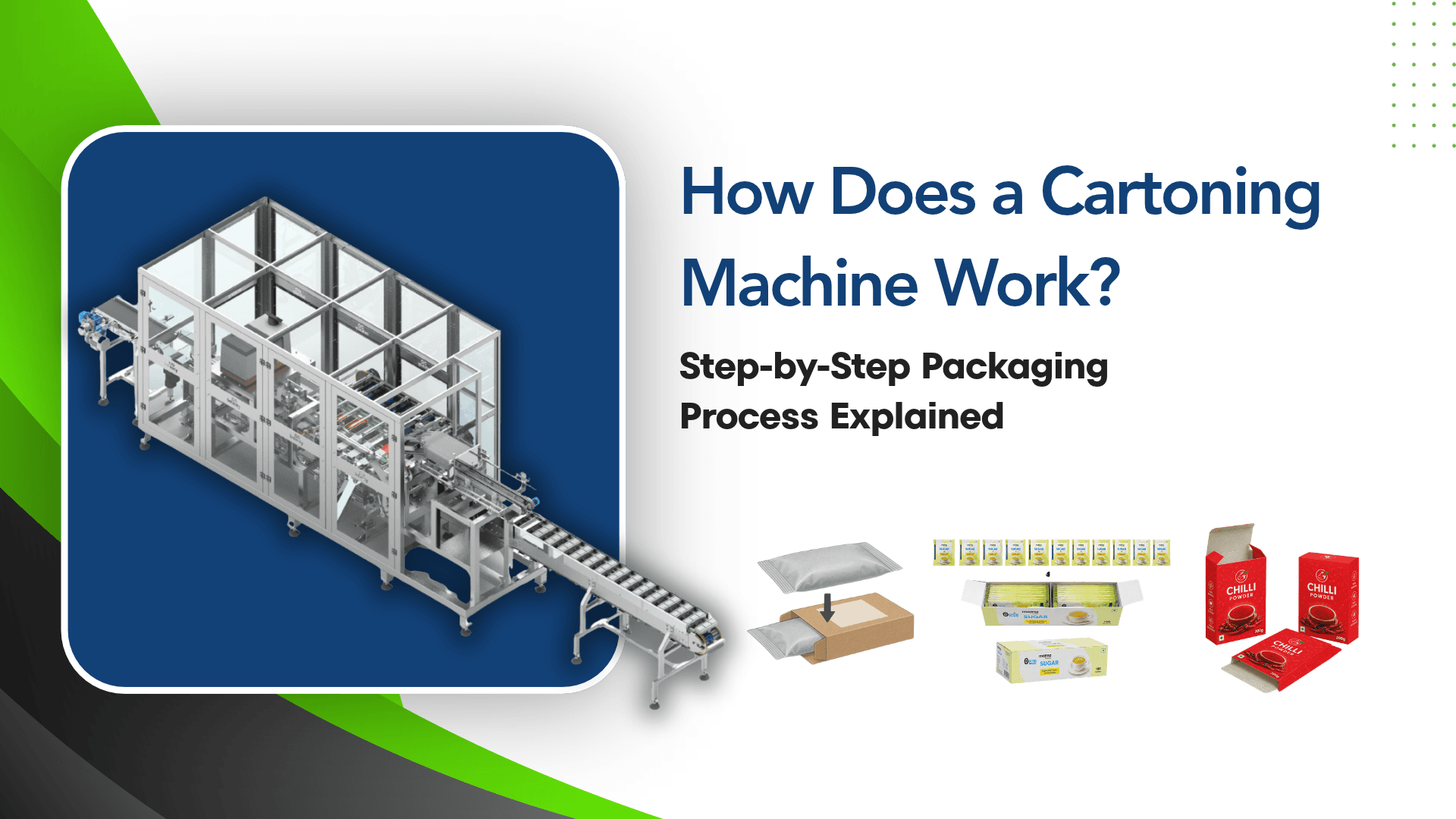
Packaging plays an important role in protecting products during storage, transportation and handling. In industries such as food, pharmaceuticals, FMCG and cosmetics, products need proper packaging before they reach the market.
A cartoning machine helps manufacturers automate this packaging process. It takes flat carton blanks, forms them into boxes, inserts products and closes the cartons through a mechanical tuck-in or glue sealing system.
Compared to manual carton packing, an automatic cartoning machine improves production speed, maintains packaging consistency and reduces manual handling. But how does a cartoning machine actually work?
Let's understand the complete cartoning process step by step.
What Is a Cartoning Machine?
A cartoning machine is a secondary packaging machine used to pack products into pre-designed paperboard cartons.
It automatically performs different operations, including:
• Feeding flat carton blanks.
• Opening and forming cartons.
• Folding and sealing bottom flaps.
• Feeding products into cartons.
• Inserting leaflets or instruction sheets.
• Closing and sealing top flaps.
• Discharging finished cartons.
Depending on the machine design, cartons can be closed using mechanical tuck-in flaps or hot-melt glue.
An automatic cartoning machine is commonly used for packing bottles, tubes, pouches, sachets, blister packs and other products.
How Does a Cartoning Machine Work? Step-by-Step Process
An automatic cartoning machine performs multiple operations in a continuous sequence. Each operation is important to ensure that the product is correctly packed inside the carton.
Let's understand each step.
Step 1: Carton Feeding
The first step is feeding flat carton blanks into the machine.
Carton blanks are loaded into a dedicated magazine. These blanks are specially designed and pre-cut according to the required carton size and shape.
The machine's carton feeding mechanism picks one carton blank at a time from the magazine and transfers it to the carton opening section.
This system ensures a continuous supply of cartons for the packaging process.
Key operation:
• Flat cartons are stored in the magazine.
• The feeding mechanism picks individual carton blanks.
• Each blank is transferred to the forming station.
Step 2: Carton Opening and Forming
After carton feeding, the machine opens the flat carton blank and converts it into a three-dimensional box.
The carton opening mechanism uses mechanical movements, suction or other suitable arrangements to open the carton into the required shape.
Once opened, the carton is positioned and held properly for the next operation.
This step is important because the carton must maintain its correct shape during product insertion.
Key operation:
• The flat carton is picked from the magazine.
• The carton is opened into its box shape.
• The carton is positioned for bottom flap closing.
Step 3: Bottom Flap Folding and Sealing
After carton forming, the bottom flaps are folded to prepare the carton for product loading.
Depending on the carton design and machine configuration, the bottom flaps can be closed using mechanical folding and tuck-in arrangements or hot-melt adhesive.
In the gluing system, hot-melt glue is applied at the required position. The flaps are then pressed together to create a secure bottom closure.
Proper bottom sealing is necessary to support the product weight and prevent products from falling out during the packaging process.
Key operation:
• Bottom flaps are folded in the correct sequence.
• Glue is applied when the glue-sealing option is used.
• The flaps are pressed together.
• The carton moves forward for product insertion.
Step 4: Product Feeding and Insertion
This is one of the most important stages of the cartoning process.
Products are supplied to the machine through a suitable product feeding system. Depending on the product type, the feeding arrangement can be designed for bottles, tubes, pouches, sachets, blister packs or other items.
The product feeding mechanism controls the movement and positioning of products before they enter the carton.
Once the carton reaches the loading position, the product is transferred and inserted into the opened carton.
The machine ensures proper coordination between carton movement and product feeding to maintain accurate insertion.
Key operation:
• Products are supplied through the feeding system.
• Products are positioned in the required orientation.
• The carton reaches the product loading station.
• The product is inserted into the carton.
For products requiring multiple units in one carton, the feeding system can be designed according to the required product arrangement.
Step 5: Leaflet or Instruction Sheet Insertion
Some products require an instruction manual, leaflet or product information sheet inside the carton.
An automatic cartoning machine can be equipped with an inline leaflet feeding system.
The leaflet feeder picks an individual folded leaflet and inserts it into the carton along with the product.
This operation is especially useful in pharmaceutical, healthcare and consumer goods packaging, where product information needs to be included inside every carton.
Key operation:
• Leaflets are loaded into the leaflet magazine.
• The feeder picks one leaflet.
• The leaflet is transferred to the insertion position.
• It is placed inside the carton with the product.
Step 6: Top Flap Folding and Carton Closing
After product and leaflet insertion, the carton moves to the closing station.
At this stage, the top flaps are folded in a specific sequence to close the carton.
The ACM-100 automatic cartoning machine supports two main closing methods:
1. Tuck-In Closing
In this method, the carton flaps are mechanically folded and tucked into the carton slots.
It does not require adhesive for closing when the carton design supports tuck-in locking.
2. Hot-Melt Glue Closing
In this method, hot-melt adhesive is applied to the required carton flap.
The machine folds the flap and presses it against the carton surface to create a strong and secure seal.
The closing method depends on the carton design, product requirements and packaging specifications.
Step 7: Batch Coding and Product Identification
After carton closing, product identification and traceability information can be printed on the carton.
Depending on the production requirement, the machine can support different coding technologies, such as:
• Inkjet printing.
• Laser coding.
• Thermal printing.
Common information printed on cartons includes:
• Manufacturing date.
• Expiry date.
• Batch number.
• Product identification.
• Other traceability details.
This helps manufacturers maintain product identification and tracking throughout the supply chain.
Step 8: Check Weighing and Rejection
For applications where product weight verification is required, an inline checkweighing system can be integrated into the packaging line.
The system checks the weight of each finished carton against the specified weight range.
If a carton is underweight or overweight, the rejection system can automatically remove it from the production line.
This helps maintain packaging quality and reduces the chances of incorrect product quantities reaching customers.
Step 9: Finished Carton Discharge
After completing all packaging operations, the finished cartons are discharged from the machine.
The cartons can then move to the next packaging stage, depending on the production line arrangement.
For example:
• Carton bundling.
• Case packing.
• Shrink wrapping.
• Secondary packaging.
• End-of-line palletizing.
This completes the cartoning process.
Complete Cartoning Process Flow
The complete working process of an automatic cartoning machine can be understood through the following sequence:
1. Carton blank feeding.
2. Carton opening and forming.
3. Bottom flap folding and sealing.
4. Product feeding.
5. Product insertion.
6. Leaflet insertion (if required).
7. Top flap folding.
8. Tuck-in or hot-melt glue sealing.
9. Batch coding.
10. Check weighing and rejection (if integrated).
11. Finished carton discharge.
How Does the ACM-100 Automatic Cartoning Machine Work?
Infinity Automated Solutions offers the ACM-100 Automatic Cartoning Machine, designed to automate carton forming, product insertion and carton closing.
The machine uses a continuous-motion cartoning system to handle products and cartons smoothly during production.
Some important features of the ACM-100 include:
• High-speed operation: Designed for production speeds of up to 100 cartons per minute.
• Accurate product feeding: Supports single or multiple product feeding according to the application.
• Flexible closing options: Mechanical tuck-in and hot-melt glue closing.
• Inline leaflet feeding: Automatic insertion of instruction sheets and leaflets.
• Coding integration: Supports inkjet, laser and thermal printing.
• Quality control: Checkweighing and rejection system integration.
• Product flexibility: Suitable for bottles, tubes, pouches, sachets, blisters and other products.
The machine is designed for high-volume packaging applications where manufacturers need consistent carton quality and reduced manual intervention.
Industries That Use Automatic Cartoning Machines
Automatic cartoning machines are used across different industries to improve packaging efficiency.
1. Pharmaceutical Industry
Used for packing medicine bottles, blister packs, tubes and other pharmaceutical products with instruction leaflets.
2. Food Industry
Used for packing food pouches, sachets, bottles and other packaged food products into cartons.
3. FMCG Industry
Suitable for packing personal care products, household products and consumer goods.
4. Cosmetics Industry
Used for packing cosmetic tubes, bottles, jars and other beauty products.
Benefits of Using an Automatic Cartoning Machine
Installing an automatic cartoning machine offers several advantages to manufacturers.
• Improved production speed: Automates carton forming, product insertion and closing.
• Consistent packaging quality: Maintains uniform carton formation and sealing.
• Reduced manual handling: Minimises the need for manual carton packing.
• Better product protection: Proper carton closing helps protect products during storage and transportation.
• Flexible packaging: Supports different product types and carton designs, depending on machine configuration.
• Production line integration: Can be connected with upstream and downstream packaging equipment.
Conclusion
A cartoning machine plays an important role in modern secondary packaging operations. From feeding flat carton blanks to forming boxes, inserting products, adding leaflets and sealing cartons, it automates several packaging operations in a single system.
For manufacturers looking to improve packaging speed, consistency and operational efficiency, an automatic cartoning machine can be an effective solution.
Infinity Automated Solutions designs and manufactures automatic cartoning solutions for different product types and industrial packaging requirements.
Looking to automate your carton packaging process?
Explore the ACM-100 Automatic Cartoning Machine by Infinity and connect with our team to discuss your packaging requirements.
Website: https://infinitysols.com/
Contact: +91 84849 22042
Email: info@infinitysols.com